English
 Español
 عربى
عربى

Content
- 1 Understanding Thermal Runaway and the Cable Risk
- 2 How Thermal Sleeving Interrupts Propagation
- 3 Selecting the Right Material for Battery Cable Sleeving
- 4 Key Performance Criteria for EV Applications
- 5 Installation and Integration Best Practices
- 6 Frequently Asked Questions
- 6.0.1 Q1: Can thermal sleeving completely prevent thermal runaway?
- 6.0.2 Q2: What is the difference between heat-resistant sleeving and fire-retardant sleeving?
- 6.0.3 Q3: Does thermal sleeving add meaningful weight or volume to the battery pack?
- 6.0.4 Q4: How should thermal sleeving be inspected over the vehicle lifecycle?
- 7 Conclusion: A Practical Layer of EV Fire Safety
Electric vehicle (EV) battery packs are among the most carefully engineered systems in modern transportation, yet the risk of thermal runaway still drives much of the industry's fire-safety research. When a single lithium-ion cell undergoes an internal short circuit and releases its stored energy as heat, the temperature in the affected module can rise faster than the pack's cooling system can respond. In that window, cables and wiring harnesses can become an unintended path for thermal runaway propagation.
Thermal sleeving offers a practical, lightweight barrier that slows heat transfer, blocks flame contact, and protects the cable network connecting cells, modules, and the traction system. This article explains how thermal sleeving protects EV battery cables from thermal runaway propagation and what to consider when selecting materials for this demanding application.
Understanding Thermal Runaway and the Cable Risk
Thermal runaway begins when a cell is mechanically damaged, overcharged, or exposed to an external heat source. The cell's internal temperature climbs, triggering decomposition of the electrolyte and separator. The result is a rapid release of heat and, frequently, the ejection of burning gases. If that heat reaches neighboring cells, the event can propagate across the module and, in extreme cases, the entire pack.
Cable harnesses are involved because they run directly between cells and modules and along the boundaries where thermal events are most likely to occur. A harness with a standard plastic jacket can soften, melt, or ignite when it contacts a high-temperature surface. Once ignited, cable insulation becomes additional fuel that extends the event and produces toxic smoke. In a purely electrical sense, a failed cable can also short adjacent structures, creating new ignition sources.
The protection problem therefore has two parts: preventing the cable itself from becoming fuel, and stopping the cable from conducting heat or flame to undamaged parts of the pack. Thermal sleeving addresses both by surrounding the cable with a fire-resistant, low-thermal-conductivity barrier. As with any protective measure, the material must be matched to the expected energy of the event, which is why engineers treat high-temperature-resistant sleeving as a system component rather than a simple wrap.
How Thermal Sleeving Interrupts Propagation
A thermal sleeve performs three distinct jobs during a thermal event. Understanding these functions helps engineers specify the right fiber, wall thickness, and construction for each harness segment.
Thermal Insulation: Slowing Heat Flow
Low-thermal-conductivity ceramic, basalt, and silica fibers create a stable air-trapping structure around the cable. When a neighboring cell exceeds 300°C, the sleeve increases the time required for that heat to soak through to the cable core. This delay matters because the pack's venting and suppression systems frequently need a few seconds to respond.
Flame Blocking: Depriving the Event of Fuel
A fire-rated sleeve does not simply resist heat; it stops the cable jacket from melting and igniting. This function matters most in a direct flame or ejected-gas scenario. A flame-retardant sleeve chars on the outside while the cable inside remains below its ignition temperature, preventing flame propagation along the harness.
Radiant Heat Reflection: Reducing Surface Load
Radiant heat from an adjacent burning cell can raise the surface temperature of nearby cables even without direct contact. Aluminum-foil composite sleeving reflects a large portion of that radiant energy, keeping the protected cable significantly cooler than its surroundings. In dense pack layouts where cables must pass close to high-risk zones, a reflective layer can reduce thermal exposure by several hundred degrees.
These three functions are not mutually exclusive. Many EV harnesses combine a fiber base layer with a foil or coated outer layer, giving the cable both insulation and reflection in one component. For a deeper look at how flame-resistant materials are tested and classified, see our complete guide to fire-retardant sleeving.
Selecting the Right Material for Battery Cable Sleeving
Not all thermal sleeving is equally suited to the EV environment. The battery compartment combines heat, vibration, sharp bracket edges, and high electrical voltages, so the selected material must balance temperature performance, mechanical toughness, and electrical compatibility.
| Material | Temperature Range | Key Advantage | Typical Use |
|---|---|---|---|
| Fiberglass | up to ~550°C | Cost-effective baseline | General-purpose harness protection |
| Basalt fiber | up to ~700°C | Tough and moisture-resistant | Cable runs near pack edges and enclosures |
| High-silica fiber | up to ~1000°C | Superior fire resistance | High-voltage lines near cell stacks |
| Ceramic fiber | up to ~1260°C | Extreme heat stability | Close-proximity shielding to cells |
| Aluminum-foil composite | Reflective layer | Radiant heat reflection | Lines beside inverters, motors, and hot surfaces |
For propagation-focused protection near cell groups, ceramic fiber sleeving offers the highest temperature margin, while basalt fiber sleeving provides a strong balance of heat resistance, abrasion performance, and flexibility. Both are available in braided and knitted constructions that follow the natural routing of a cable harness.
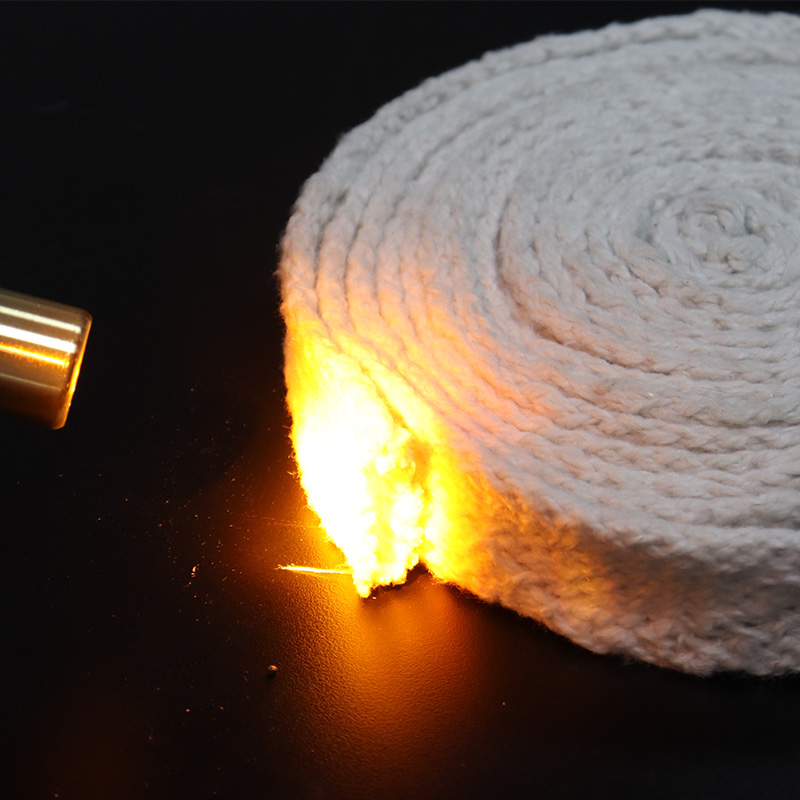 High-Temperature Ceramic Fiber Sleeve for Cable InsulationThis sleeve withstands continuous heat up to 1000°C and resists flame and molten metal. Placed after a discussion of propagation-focused protection, it suits users needing maximum thermal margin near cell groups.View Product →
 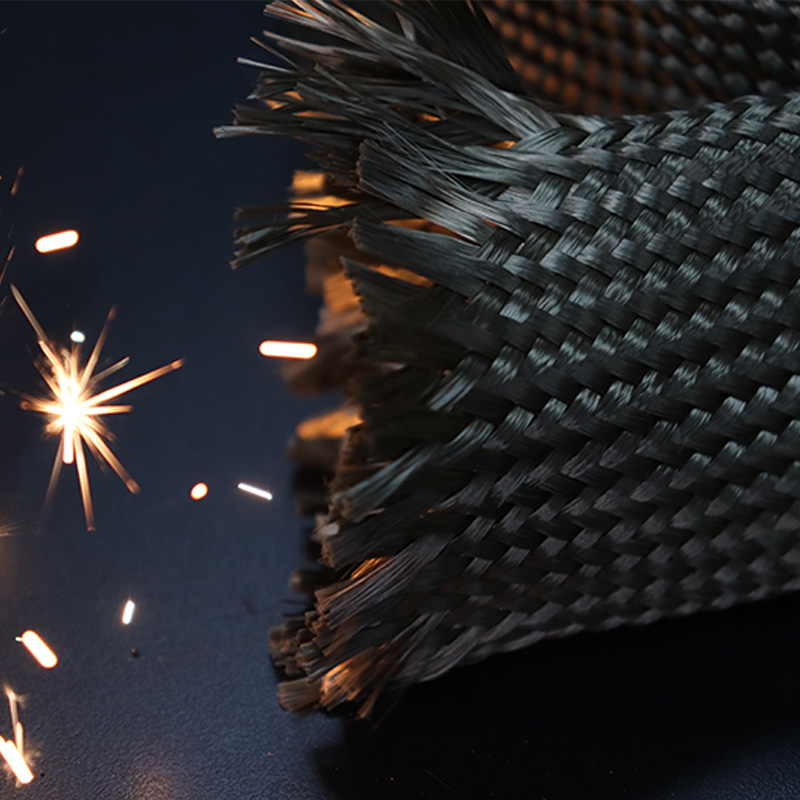 Basalt Fiber Sleeve for Extreme Temperature Cable ProtectionWith an operating range from -260°C to 1200°C and resistance to acids, alkalis, and radiation, this sleeve fits demanding aerospace, rail, and automotive applications where balanced thermal and mechanical performance is required.View Product →
Key Performance Criteria for EV Applications
When specifying thermal sleeving for battery cables, verified performance data matters more than general marketing claims. The criteria below should be reviewed with the material supplier before integration.
- Continuous and peak temperature rating: the rating must exceed the worst-case temperature of the adjacent cell event, not just the cruising temperature of the pack.
- Flame resistance: look for self-extinguishing behavior equivalent to UL VW-1 or similar vertical flame tests.
- Thermal conductivity: lower values mean a longer delay before heat reaches the cable core.
- Abrasion resistance: braided and knitted constructions resist chafing against bracket edges and cable ties.
- Electrical compatibility: fibers should be non-conductive and stable under high voltage and high humidity.
- Flexibility and bend radius: the sleeve must follow the harness without kinking or opening gaps at the seams.
A thermal sleeve is only useful if it remains intact for the full duration of the event. Choose a material rated well above the hottest credible cell temperature in the pack and verify its flame behavior with a real sample test.
Installation and Integration Best Practices
Even a correctly specified sleeve will underperform if it is installed with gaps or insecure terminations. In battery pack assembly, the following practices improve propagation resistance.
- Cover the full harness length, including connector transitions, with no exposed jacket segments.
- Overlap heat-shrink or tape layers at the ends to keep the sleeve fixed and prevent moisture ingress.
- Use two-layer constructions at the highest-risk zones, such as busbar crossings and cable-to-module exits.
- Allow a small service loop at the connector end so the sleeve does not stretch or pull during vehicle vibration.
- Combine the sleeve with a self-adhesive or hook-and-loop wrap tape where service access is required.
- Record the installation in the pack's service documentation so technicians can inspect the protected areas during maintenance.
Because thermal propagation protection is a system property, the sleeving should be validated together with the pack's venting, cooling, and battery-management response. A robust fire-rated sleeve protects the cable network and buys time for these systems to contain the event.
 Fire Retardant Silicone-Coated Sleeve for Flame ProtectionThis sleeve protects cables from molten metal, open flames, and radiant heat while providing electrical insulation. It is relevant where fire-rated sleeving supports thermal propagation containment in battery packs and industrial equipment.View Product →
Frequently Asked Questions
Q1: Can thermal sleeving completely prevent thermal runaway?
No. Thermal sleeving is a propagation barrier, not a suppression system. It slows heat flow, blocks flame contact, and protects cable integrity so that a single-cell event does not rapidly spread through the wiring network. Complete prevention depends on cell quality, battery management, cooling, and venting working together.
Q2: What is the difference between heat-resistant sleeving and fire-retardant sleeving?
Heat-resistant sleeving maintains its structure and insulating value at high temperatures, while fire-retardant sleeving is specifically tested to resist ignition and stop flame spread. For EV battery cables, the two properties overlap: an effective thermal sleeve provides both thermal insulation and flame resistance.
Q3: Does thermal sleeving add meaningful weight or volume to the battery pack?
Fiber-based sleeving is lightweight, typically adding only a few grams per meter of cable, and its wall thickness can be selected to match the available routing space. The trade-off is very small compared to the cost and complexity of a pack-level fire event.
Q4: How should thermal sleeving be inspected over the vehicle lifecycle?
During regular high-voltage service intervals, technicians should check for chafing at brackets, discoloration from sustained heat, loosening at connector ends, and contamination by oil or coolant. Damaged sections should be replaced immediately rather than repaired with tape.
Conclusion: A Practical Layer of EV Fire Safety
Thermal runaway propagation follows the path of least resistance, and unprotected cables are often exactly that. Thermal sleeving interrupts the path by insulating the cable core, blocking flame contact, and reflecting radiant heat away from critical harness segments. When the material is selected against real event temperatures and installed as part of a validated pack design, it adds a meaningful layer of safety without compromising the weight, space, or serviceability of the vehicle.
For EV engineers and battery pack integrators, the takeaway is clear: the cable network deserves the same thermal protection discipline as the cells themselves.