English
 Español
 عربى
عربى

Content
- 1 The Unseen Dangers Lurking in High-Temperature Environments
- 2 What Makes Aluminized Split Sleeves a Superior Solution for Heat Protection?
- 3 The Science of Reflection: How a Thermal Barrier Sleeve Works
- 4 Beyond the Engine Bay: Versatile Applications for Reflective Wire Looms
- 5 The Installation Advantage: Why a Hook and Loop Closure Changes Everything
- 6 Choosing the Right Thermal Protection for Your Critical Components
In complex machinery, high-performance vehicles, and industrial settings, a web of intricate wiring and fluid-carrying hoses acts as the central nervous system. These components are responsible for transmitting power, data, and vital fluids, ensuring everything operates as intended. However, these critical pathways are often forced to exist in close proximity to sources of intense heat, such as exhaust manifolds, turbochargers, and industrial furnaces. The threat posed by this heat is not just conductive (direct contact) but, more insidiously, radiant heat. This invisible energy, an electromagnetic wave, travels through the air and can silently degrade components, leading to catastrophic failures that are often misdiagnosed until it is too late. Understanding and mitigating this threat is not just a matter of maintenance; it is a fundamental aspect of system reliability and safety.
The Unseen Dangers Lurking in High-Temperature Environments
Many standard wire insulators and hose materials are simply not designed to withstand prolonged exposure to high levels of radiant heat. When these components are subjected to temperatures beyond their operational threshold, a cascade of degradation begins. Insulating plastics and rubbers become brittle, crack, and eventually flake away, exposing the conductor underneath. This leads to intermittent shorts, signal loss, or complete circuit failure. In the case of hoses carrying fuel, oil, or hydraulic fluid, the heat can cause the material to harden and split, resulting in dangerous leaks that pose a significant fire risk, especially in an already-hot engine bay. The problem is that radiant heat does its damage quietly. A visual inspection might not reveal the extent of the thermal fatigue until the component is already compromised, making proactive protection an absolute necessity for anyone wondering how to protect engine bay wiring from radiant heat.
What Makes Aluminized Split Sleeves a Superior Solution for Heat Protection?
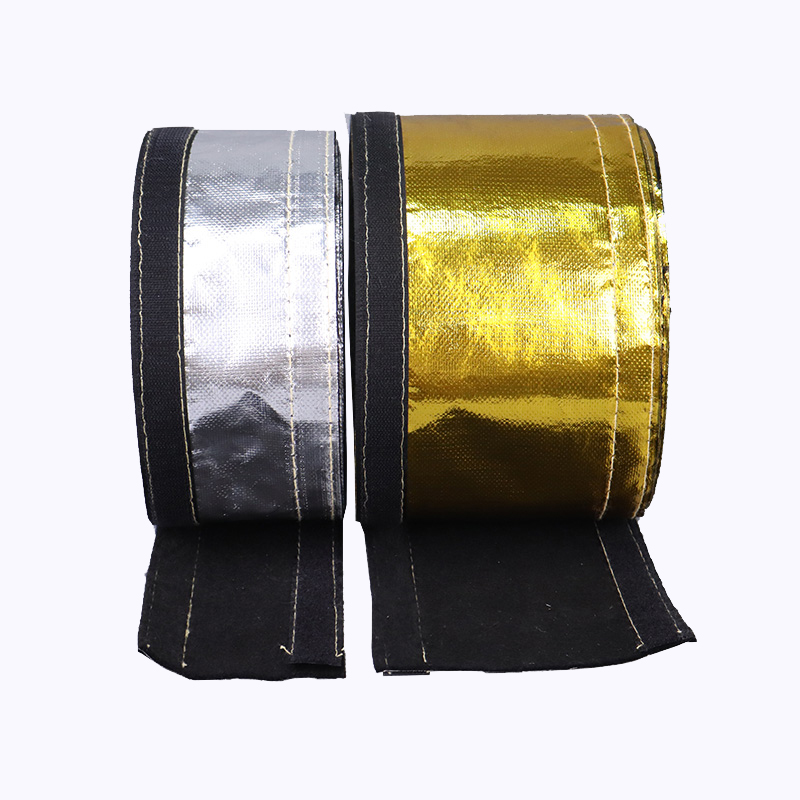
When faced with extreme thermal challenges, simple rerouting is often not an option. This is where specialized protective materials become essential. An aluminized split sleeve for heat protection represents one of the most effective and versatile solutions available. This type of sleeving is a composite product. It typically consists of a durable, heat-resistant base layer, often made from materials like fiberglass or silica, which provides a strong insulating foundation. This base layer is then laminated with a highly reflective, high-purity aluminum foil outer layer. The "split" design refers to the fact that the sleeve is not a seamless tube; it is open along its length, allowing it to be wrapped around existing components without the need for disassembly. This combination of a reflective surface and an insulating core creates a powerful defense against the very worst thermal environments.
The Science of Reflection: How a Thermal Barrier Sleeve Works
The primary defense mechanism of an aluminum foil-based sleeve is reflection. Radiant heat travels in a straight line, and when it encounters a bright, mirror-like surface, a significant portion of that energy is reflected away. A hook and loop thermal barrier sleeve with an aluminized surface can reflect upwards of ninety percent of all radiant heat it encounters. This is fundamentally different from standard insulation, which merely slows the transfer of heat. By reflecting the heat energy away entirely, the sleeve prevents the heat from ever reaching the sensitive components within. The underlying insulating layer of fiberglass or other high-temperature fabric handles the small percentage of heat that is not reflected, as well as any conductive heat in the surrounding air. This dual-action approach—reflecting radiant heat and insulating against ambient heat—ensures the wires, cables, or hoses inside remain at a stable, safe operating temperature.
Beyond the Engine Bay: Versatile Applications for Reflective Wire Looms
While the automotive world is a primary beneficiary of this technology, the utility of a reflective wire loom with velcro closure extends far beyond high-performance cars. In industrial manufacturing, these sleeves are critical for protecting sensor wires and pneumatic lines on casting equipment, welding robots, and metal-forming presses. In aerospace, they shield critical flight control wiring from engine heat and exhaust. Even in a home or commercial setting, they can be used to protect cables that must run near furnaces, water heaters, or high-intensity lighting. Any environment where a delicate component is exposed to a significant radiant heat source is a potential application. The sleeve acts as a versatile, easy-to-deploy thermal shield, ensuring data integrity, preventing fluid degradation, and dramatically extending the service life of the components it protects.
The Installation Advantage: Why a Hook and Loop Closure Changes Everything
The true genius of this design lies in its practicality. In the past, installing thermal protection often meant a complete teardown of the system. Wires had to be de-pinned from their connectors, and hoses had to be drained and disconnected, just to slide on a seamless protective tube. This process was time-consuming, expensive, and introduced new risks of incorrect reassembly. The integration of a high-temperature hook and loop (Velcro) closure system revolutionizes this process. This "easy install" design allows the sleeve to be opened flat, wrapped around the existing wire harness or hose, and then securely sealed. This makes it an ideal solution for retrofitting protection onto existing systems. An automotive heat reflective sleeve easy install solution means that critical protection can be added in minutes, not hours, drastically reducing labor costs, minimizing downtime, and making vital thermal safety accessible for both professional mechanics and hobbyists.
Choosing the Right Thermal Protection for Your Critical Components
When selecting a thermal sleeve, it is important to assess the specific needs of the application. Not all reflective sleeves are created equal. Key factors to consider include the maximum continuous and intermittent temperatures the sleeve will be exposed to. It is also crucial to ensure the diameter of the sleeve is appropriate; a sleeve that is too tight will not provide an adequate air gap for insulation, while one that is too loose may be inefficient. The quality of the aluminized outer layer and the durability of the closure system are paramount. A robust hook and loop fastener will ensure the sleeve stays closed and maintains its protective integrity, even when subjected to vibration and flexing. By thoughtfully selecting the right sleeve, you can provide a reliable and long-lasting shield, safeguarding your most critical systems from the pervasive and destructive power of radiant heat.