English
 Español
 عربى

Content
- 1 What Is Basalt Fiber?
- 2 How Is Basalt Fiber Manufactured?
- 3 Key Properties of Basalt Fiber
- 4 Basalt Fiber vs. Glass Fiber: A Head-to-Head Comparison
- 5 Why Is Basalt Fiber Considered Eco-Friendly?
- 6 Practical Applications of Basalt Fiber in Industry
- 7 Limitations and Considerations
- 8 Frequently Asked Questions
- 9 Conclusion
As industries face growing pressure to reduce their environmental footprint, material selection has become a strategic decision rather than a purely technical one. Engineers who once defaulted to glass fiber are now weighing performance alongside sustainability. Basalt fiber has emerged as a compelling answer: a high-performance, volcanic-rock-derived fiber with a cleaner manufacturing profile and comparable, often superior, thermal and mechanical performance. This article explains what basalt fiber is, how it is made, and why it is increasingly recognized as the eco-friendly alternative to glass fiber.
What Is Basalt Fiber?
Basalt fiber is a continuous filament produced by melting crushed volcanic basalt rock at temperatures around 1,400-1,500°C and drawing the molten material through fine nozzles to form thin, strong fibers. Its chemical composition mirrors that of the source rock and typically includes silica (around 52%), alumina (around 17%), iron oxides, calcium oxide, and magnesium oxide.
Because these elements occur naturally in the rock, basalt fiber can be manufactured without the added boron, fluorine, or other chemical fluxes commonly used in glass fiber production. This one-material characteristic gives basalt fiber a notably clean environmental profile while preserving the thermal and mechanical performance that industrial applications demand.
Basalt fiber was first studied in the Soviet Union during the 1950s and 1960s, and commercial production has expanded steadily since the 1990s. Today it is available as continuous filaments, chopped strands, woven fabrics, sleeves, tapes, and mats, making it practical for a wide range of high-temperature and structural uses.
How Is Basalt Fiber Manufactured?
Basalt fiber production follows a straightforward process that relies entirely on natural rock:
- Crushing: Quarried basalt rock is cleaned, sorted, and crushed into small aggregates.
- Melting: The crushed rock is melted in a furnace at approximately 1,400-1,500°C.
- Extrusion: The molten basalt is forced through platinum-rhodium bushings to form continuous filaments.
- Drawing: The filaments are drawn to the desired diameter and cooled.
- Sizing and winding: A thin, eco-friendly sizing agent protects the filaments, which are then wound onto spools or chopped to length.
No chemical additives are required at any stage. The elemental makeup of the raw basalt rock provides the full chemistry of the finished fiber, which is why basalt fiber is often described as a naturally sustainable industrial material.
Key Properties of Basalt Fiber
Basalt fiber's growing popularity is rooted in a well-balanced combination of thermal, mechanical, and chemical properties.
- Fire resistance: Basalt fiber is naturally incombustible and does not support flame spread.
- Chemical durability: Excellent resistance to alkalis, acids, and salt water, making it suitable for harsh industrial environments.
- Electrical insulation: Good dielectric properties allow use near wiring and electronic components.
- Moisture resistance: Low water absorption keeps performance stable in humid conditions.
- Vibration and sound damping: The fiber structure absorbs mechanical vibration and acoustic energy.
These qualities translate directly into longer equipment life, reduced maintenance intervals, and safer working conditions in high-heat environments.
Basalt Fiber vs. Glass Fiber: A Head-to-Head Comparison
The most frequent question from engineers is how basalt fiber stacks up against the glass fiber that has long dominated industrial insulation. The table below summarizes the key differences.
| Property | Basalt Fiber | E-Glass Fiber |
|---|---|---|
| Raw material | Volcanic basalt rock | Sand, limestone, borates |
| Chemical additives | None required | Boron, fluorine, other fluxes |
| Tensile strength | 3,000-4,840 MPa | 1,700-3,500 MPa |
| Elongation at break | Around 3.1% | Around 4.7% |
| Max continuous service temperature | Around 700°C | Around 450-550°C |
| Melting temperature | 1,400-1,500°C | Around 1,400°C |
| Manufacturing energy input | Lower per unit mass | Higher per unit mass |
| Relative material cost | Moderate | Lower |
Basalt fiber clearly outperforms E-glass on tensile strength and continuous service temperature, while matching glass on density and chemical stability. It also avoids the boron-based chemistry that is increasingly scrutinized for environmental reasons. The main advantage of glass fiber remains its lower purchase price, which is why the two materials are likely to coexist rather than fully replace one another.
Why Is Basalt Fiber Considered Eco-Friendly?
Basalt fiber's environmental credentials go beyond simple recyclability. They begin with the raw material itself: volcanic basalt is one of the most abundant rocks on Earth, so no energy-intensive synthetic precursor synthesis is needed. The production process also avoids the boron, fluorine, and other fluxing agents that are standard in glass fiber manufacturing, reducing both hazardous chemical use and waste treatment burden.
- No toxic additives: Basalt fiber does not release boron or fluorine emissions during production or combustion.
- Long service life: Products made from basalt fiber resist heat, moisture, and chemicals, so they require less frequent replacement.
- Safe end-of-life handling: Basalt fiber contains no organic binders that release harmful smoke when burned.
- Abundance: Basalt reserves are vast and geographically widespread, reducing supply-chain risks associated with specialized raw materials.
Practical Applications of Basalt Fiber in Industry
Basalt fiber's combination of heat resistance, mechanical strength, and environmental compatibility has opened doors across multiple industries. In high-temperature environments, it is commonly processed into sleeves, fabrics, and wrapping tapes that protect hoses, cables, and equipment. Typical sectors include: Automotive Marine Steel Chemical Fire Protection
Basalt Fiber Sleeves for Wire and Hose Protection
Braided or knitted basalt sleeves shield wiring and hoses from radiant heat, molten metal splashes, and mechanical wear. In automotive engine compartments, ship engine rooms, and steel plants, these sleeves keep critical lines functional when temperatures climb well beyond the limits of conventional polymer sleeving. The fibers also provide vibration resistance and sound damping that extend the life of adjacent components.
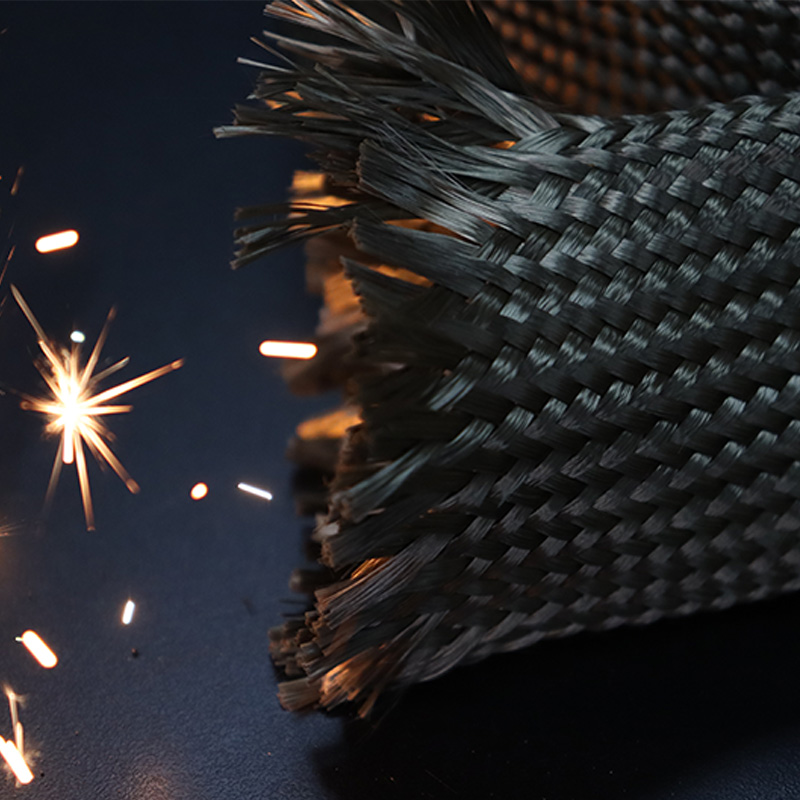 Basalt Fiber Sleeve for High-Temperature Cable and Hose ProtectionThis woven sleeve shields wiring and hoses from radiant heat, molten metal splashes, and mechanical wear. It withstands extreme temperatures from -260°C to 1200°C, making it suitable for aerospace, automotive, and industrial applications where conventional polymer sleeving fails.View Product →
Basalt Fabrics as Thermal Barriers
Woven basalt fabric is used for weld protection curtains, heat shields, expansion joints, and insulation blankets. Because the fabric remains inherently non-flammable and does not melt or drip, it is an excellent replacement for asbestos-based materials and a safer alternative in fire-rated assemblies. Coated versions add abrasion resistance and weather protection for outdoor installations.
 Basalt Fabric for Welding Protection and Thermal BarriersThis flexible, non-melting fabric offers thermal insulation and corrosion resistance for welding curtains, fire blankets, and protective equipment. Its soft texture and chemical resistance suit textile, chemical, metallurgical, and fire-safety applications, serving as a safer asbestos alternative.View Product →
Basalt Wrap Tapes for Pipes and Exhaust Systems
Self-adhesive or mechanically fastened basalt wrap tapes are a quick and effective way to insulate exhaust pipes, turbocharger lines, and industrial piping. The tape prevents heat from radiating into nearby components, improves thermal efficiency, and protects personnel from burns.
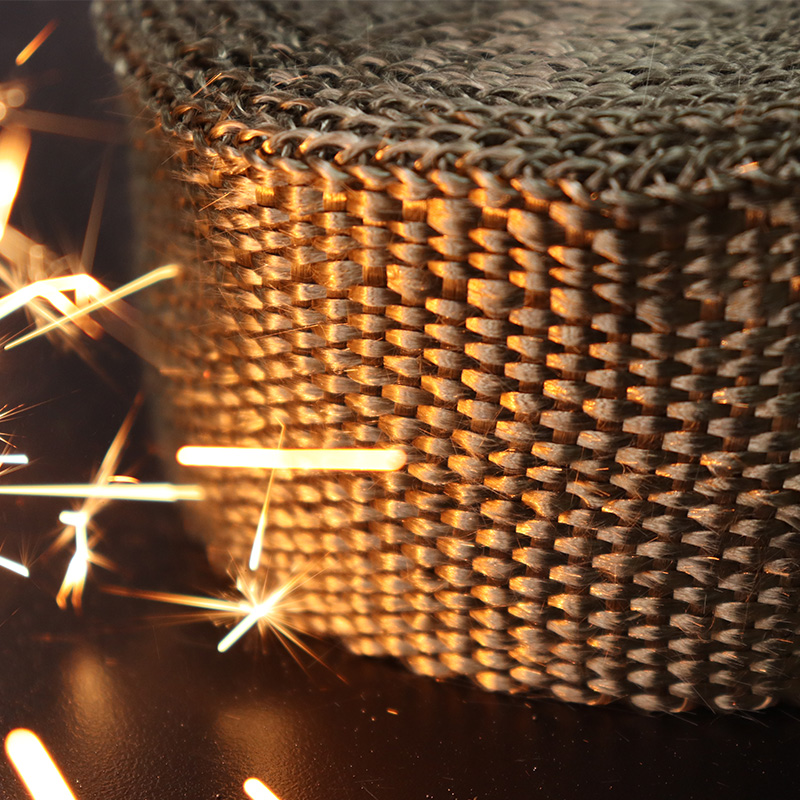 Basalt Wrap Tape for Exhaust Pipes and Industrial PipingWoven from continuous basalt fibers, this tape provides high-temperature resistance up to 700°C, corrosion resistance, and sound absorption. It is used for turbocharger lines, engine compartments, and steam pipes to reduce heat radiation and improve thermal efficiency.View Product →
Beyond these forms, basalt fiber is appearing in firefighter turnout gear, marine fire blankets, and composite reinforcement for construction panels. Its application base continues to expand as manufacturers share field data on long-term performance. Read more about the superior high-temperature performance of basalt fiber sleeving in real industrial conditions.
Limitations and Considerations
No material is without trade-offs, and basalt fiber is no exception. Its purchase price is generally higher than E-glass fiber, which can be a deciding factor in cost-sensitive, low-temperature applications. Recent market data, however, suggests that basalt fiber sleeving is closing the cost gap without sacrificing durability. The fiber also behaves differently during cutting and weaving: basalt filaments are more abrasive on tooling, so processing equipment may need adjustment.
In addition, while basalt fiber handles continuous service around 700°C, it is not a substitute for ceramic or silica fibers in applications above that threshold. Engineers should always qualify basalt products for their specific operating envelope before full-scale deployment.
Frequently Asked Questions
Q1: Is basalt fiber stronger than glass fiber?
In tensile strength, basalt fiber generally outperforms E-glass fiber, with typical values of 3,000-4,840 MPa compared with 1,700-3,500 MPa for E-glass. Basalt fiber also retains its strength better at elevated temperatures, making it the preferred choice for high-heat and load-bearing insulation applications.
Q2: What temperature can basalt fiber withstand?
Basalt fiber can be used continuously at temperatures up to approximately 700°C, with short-term exposure to higher peaks possible depending on the product construction. Its melting point is around 1,450°C, but continuous service limits are always lower than the melting point to preserve mechanical integrity.
Q3: Is basalt fiber truly eco-friendly?
Compared with glass fiber, basalt fiber requires fewer chemical additives, lower manufacturing energy, and no boron or fluorine fluxes. It is derived from an abundant natural rock and poses no significant disposal hazard, making it one of the more environmentally favorable industrial fibers available today.
Q4: Can basalt fiber fully replace glass fiber?
Basalt fiber is a strong substitute in high-temperature, chemical-resistant, and performance-sensitive environments, but glass fiber remains more economical for low-cost, moderate-duty applications. Many manufacturers select basalt for critical heat and safety zones while continuing to use glass fiber where its cost advantage is decisive.
Conclusion
Basalt fiber is more than a passing trend in industrial materials. It combines the processability of glass fiber with a higher thermal ceiling, better tensile strength, and a genuinely cleaner environmental profile. For manufacturers looking to reduce their environmental impact without sacrificing performance, basalt fiber provides an immediately available, industrially proven solution.
As production capacity expands and downstream experience accumulates, the economic gap between basalt and glass fiber is likely to narrow further. Companies that adopt basalt-based sleeving, fabric, and wrapping tape today are not only improving equipment protection but also positioning themselves ahead of stricter environmental and safety regulations.